|
Your complete satisfaction is our goal. We'd like this
newsletter to meet your diving information needs.
Please let us know what you would like to see in
future newsletters.
| In This Issue |
 |
|
| DO YOU NEED YOUR LOCAL DIVE SHOP? |
|
|
Greg Davis, owner of divebuddy.com recently sent out
post cards to more than 1200 dive centers across the
United States introducing them to DiveBuddy.com.
Divebuddy.com provides the diving community with an
extensive database of scuba divers, a scuba white
pages if you will.
Do you need your local dive shop? says Greg
Davis, I believe the answer to that question is a loud
YES! They provide us with training, gear, rental
equipment, air fills, maintenance and travel advice.
Most of them are owned by individuals or families in
your neighborhood.
As the owner of DiveBuddy.com, I ask you to stop by
your local dive shop THIS WEEKEND just to say HI!
Ask them questions, honestly tell them what you think
about their business and maybe give suggestions on
what you'd like to see them do differently OR better.
Tell them about DiveBuddy.com and encourage them
to grow their business by participating in our social
network. We can all use DiveBuddy.com to stay in
touch, share ideas and experiences and plan future
dive trips.
The post card I sent will hit their doors this week...so
stop by your local dive shop this weekend and tell
them you appreciate their service to the local dive
community in your area. Together we can build a
wonderful network of dive buddies all around the globe
Now get off the computer and go diving!
Sincerely,
Greg Davis
Owner and Member 1
|
| COCOS ISLANDS COSTA RICA - TRIP OF A LIFETIME |
|
|
Ocean Adventures is featuring a dive trip that is on
everyone's Life's Wish List... Cocos Islands, Costa
Rica oboard the Undersea Hunter.
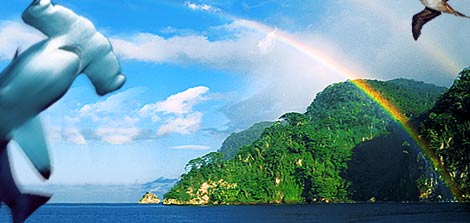
Located in the Eastern Tropical Pacific, 300 miles
southwest of Cabo Blanco, Costa Rica, lies the
famous Cocos Island Marine Park. A rugged and
incredibly beautiful island, this World Heritage Site is
the crown jewel of Costa Rica's many National Parks.
Cocos Island has an irregular coastline, which makes
estimation of land area more a matter of opinion than
a surveyor's science, but it is roughly five miles by two
The island was formed during a volcanic upheaval
about two-and-a-half million years ago and is
composed of basaltic rock, labacorite and andecite
lava flows. Its landmass is punctuated by four
mountain peaks, the highest of which is Cerro
Yglesisas, at 2,080 feet or 634 meters.
The island has two large bays with safe anchorages
and sandy beaches: Chatham is located on the
northeast side and Wafer Bay is on the northwest.
Just off Cocos are a series of smaller basaltic rocks
and islets. The largest satellite is Isla Manuelita
(formerly Nuez).
This is one of those dive trips of a lifetime
and we only have four spots left. Call OADC and ask
for Steve to reserve your spot. The trip will be August
2009.
|
| REEF-BUILDING CORALS FACE EXTINCTION |
|
|
In a first-ever comprehensive global assessment to
determine the status of coral species worldwide,
leading coral scientists warn that one third of
reef-building coral species are threatened with
extinction
Citing climate change and human-induced
destruction as causes, the Global Marine Species
Assessment (GMSA) - a joint initiative of the
International Union for Conservation of Nature (IUCN)
and Conservation International (CI) - applied the
IUCN Red List Categories and Criteria to assess over
800 coral species.
The ICRS, held every four years, is committed to
sharing the best available global reef science with
government agencies, resource management and
non-government organizations throughout the world.
Project AWARE was a sponsor organization and
worked with its CoralWatch partner, the University of
Queensland, to showcase the conservation efforts of
volunteer divers to protect coral reefs worldwide
"These results show that as a group, reef-building
corals are more at risk of extinction than all terrestrial
groups, apart from amphibians, and are the most
vulnerable to the effects of climate change," said
Roger McManus, Conservation International's Vice
President for Marine Programs and Project AWARE
Foundation's Board of Directors member. "The loss of
the corals will have profound implications for millions
of people who depend on coral reefs for their
livelihoods."
These recent findings make it clear that we need to
act now to improve corals' ability to cope with global
changes. We need to reduce our CO2 emissions and
tackle the major local drivers threatening coral reefs
such as overfishing and poor water quality, caused by
runoff of chemicals, fertilizers and sediments." states
Jenny Miller Garmendia, Director for Project AWARE
Foundation. "Together with the University of
Queensland's CoralWatch program and partners like
Reef Check and dive volunteers worldwide, there are
many opportunities for individuals to participate in reef
monitoring, education and conservation locally."
www.sci.odu.edu/gmsa/about/corals.shtml
|
| SHORE DIVES - BOAT DIVES - LET'S GET WET! |
|
|
Ocean Adventures divers are diving all the time, night
shore dives and weekend boat dives. Need a
buddy? No problem, want to improve on a skill while
out on a boat? Just ask! Call OADC at 310.578.9391
or check out the upcoming boat schedule online,
check in with the shop for any shore diving
excursions. Last one in the water...
|
|
DIVE CLUB MEETING TUESDAY, AUGUST 12 WITH MIKE WYND AND THE "GALLIPOLI SUBMARINE" PROJECT |
|
|
Join Us Tuesday, August 12, 7PM At OADC to hear
Mike Wynd talk about the "Gallipoli Submarine
Project." Originally from Melbourne, Australia, and
qualified since 1978, Mike began his technical diving
career in 2000 upon returning to Sydney after an eight
year stint in Auckland, New Zealand. Once in Sydney
Mike joined 'The Sydney Project', a diverse group of
dedicated divers whose mandate it is to discover,
catalogue and map previously undiscovered
shipwrecks, primarily those beyond the limits of
recreational scuba, along the New South Wales coast.
The demands of 'The Sydney Project' dives lead Mike
to move towards training with rebreathers, and in
2003 he became qualified on the Inspiration Closed
Circuit Rebreather.
With experience on dives up to 400 feet, Mike was
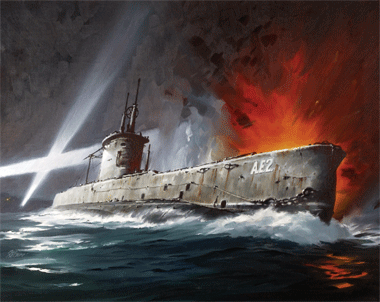
asked to join the AE2 Expedition in November 2006.
The expedition's mission was to ascertain the
condition and feasibility of raising an Australian World
War One submarine scuttled during the Gallipoli
campaign of 1915. AE2 was discovered in 1995 lying
upright and completely intact in 240 feet of water in the
Sea of Marmara, just north of The Dardanelles, Turkey.
HMAS AE2 was the first Allied submarine to penetrate
the Dardanelles in 1915 as part of the Gallipoli
Campaign, on the very morning the ANZAC soldiers
landed at Anzac Cove. After five hectic days "running
amok", she finally fell to Turkish gunfire and was
scuttled. Her crew was captured and spent the rest of
the war as Turkish POWs. AE2 lay, unseen, until in
1998 she was discovered, intact, in 73m of water in
the Sea of Marmara. The SIA aims to ensure the
protection, preservation and promotion of AE2, to
contribute to an informed debate on her future and
ensure that AE2's contribution to the Gallipoli
campaign is duly recognized by telling the story of her
brave crew.
In September 2007, the government funded
expedition, set out to survey AE2 and this
quest was filmed by an Australian and English co-
production team to become the documentary "Gallipoli
Submarine."
Project AE2 - The Silent ANZAC |
|